
Maplewood City Directory Collections
The best documented shelf for Maplewood research is maintained by Saint Paul Public Library. Its volumes belong to the Saint Paul directory system, so they are useful only after the printed place and street are checked against the geography of that year. The set is still valuable for Maplewood because the city grew from townships, annexed areas, a 1957 village, and a 1974 city. An earlier household can appear under a rural, township, Saint Paul, or neighboring-place description instead of the modern city name.
| Collection | Years | Where Held | Access |
|---|---|---|---|
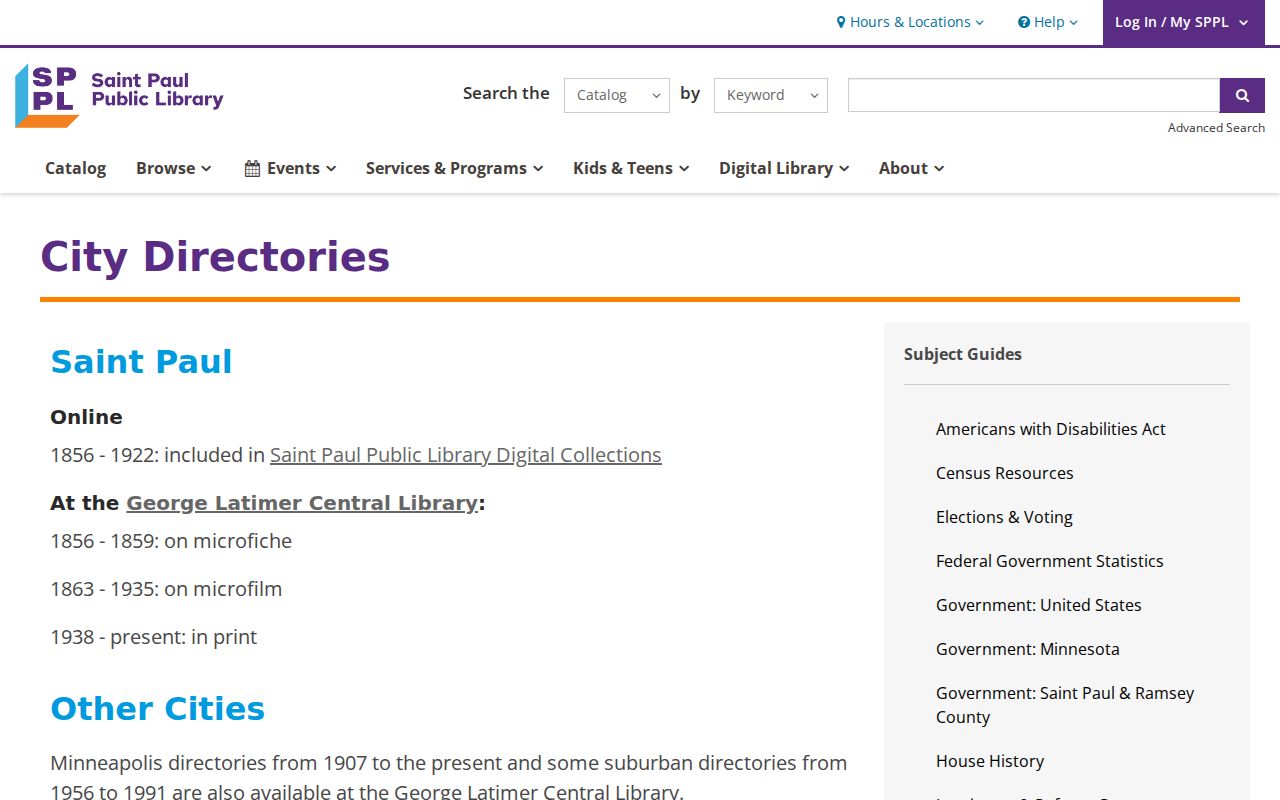
| Saint Paul city directories | Online 1856-1922 | SPPL digital collections | Online |
| Saint Paul city directories | Microfilm 1863-1935 | George Latimer Central Library | In-library microfilm |
| Saint Paul city directories | Print 1938-present | George Latimer Central Library | In-library print |
| Suburban directories | Some years about 1956-1991 | SPPL, MNHS, and library catalogs | Verify volume and geography |
The exact Maplewood run was not located in the official collection description. That is an important limit, not a reason to fill the gap with an assumed date range. Check each volume for suburb coverage, then retain the directory title, year, page, and printed place wording with the household note.
Maplewood Directory Coverage Gap
A complete-looking directory shelf is not a complete Maplewood resident roll. SPPL says some suburban directories begin around 1956, but its page does not identify an uninterrupted Maplewood sequence. A listing may be absent because the area was rural, outside the volume's service area, entered under a nearby city, or represented by a rural route. A surname can also be filed under a spouse, an initial, or a business name.
Keep the historical boundary separate from the modern boundary. Ramsey County began in 1849, while the municipality's later village and city milestones changed the labels researchers see. This is the practical correction to the common assumption that one city-directory search covers every local household back through time.
Note: A missing directory entry is a research gap, not proof that a person never lived near present-day Maplewood.
Maplewood Directory Access Routes
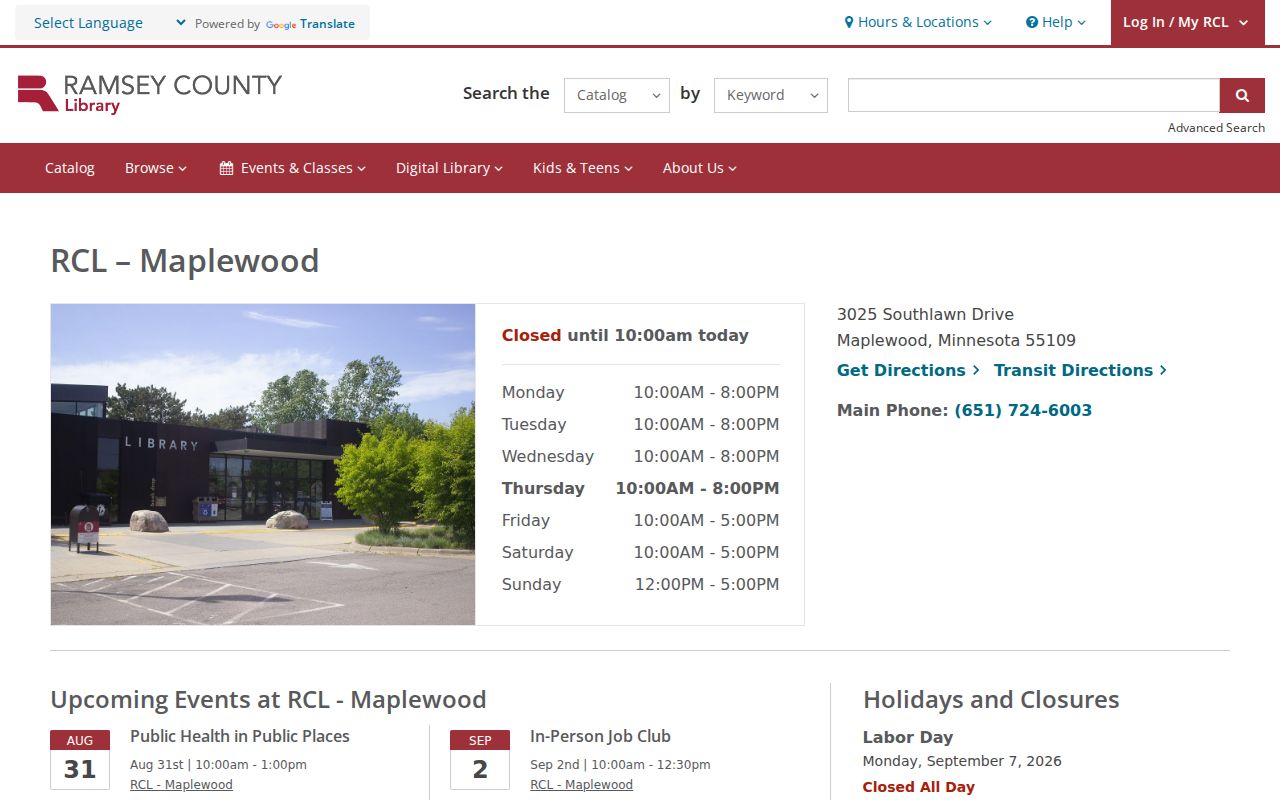
The Ramsey County Library - Maplewood is the convenient local access point for computers, scanning, photocopying, and help reaching licensed research tools. Its branch database options include Ancestry Library Edition in the library, FamilySearch, Data Axle Reference Solutions, Pioneer Press and Star Tribune archives, and the Minnesota Digital Newspaper Hub. The branch closed for renovation in December 2022 and reopened in fall 2023, so older descriptions of a temporary closure are outdated.
The Maplewood branch is a practical place to start a directory search before traveling to Saint Paul. The library database list identifies which resources are in-library or library-card services, while staff can help distinguish a searchable index from a scanned volume.
The Maplewood branch provides an in-person gateway to the historical research tools described above.
Use a scan or photograph of the title page, entry page, and abbreviation key so another researcher can identify the exact city-directory volume later.
For a limited lookup, the Minnesota Historical Society Gale Family Library offers paid research services. Its city-directory request covers one name in up to five years for a $5 processing fee. The Ramsey County Historical Society adds finding aids, county collections, Saint Paul building-permit material, and research-center guidance. Maplewood-specific farm, cemetery, and community context is also available through the Maplewood Area Historical Society.
How Directory Fields Changed
Read a volume according to its own year. The SPPL collection records a shift from early resident and business entries with street names and occupations to later address, household, owner, and telephone clues. A detail that appears in one year is not necessarily present in the next, so an abbreviation key and the volume's introductory pages matter as much as the name line.
- 1856: the online Saint Paul run begins; early entries may lack house numbers.
- 1879: a street-name index added to/from directions.
- 1885: house numbers begin appearing in the documented field evolution.
- 1929: a dotted circle could mark a homeowner, and wives' names could follow a husband.
- 1933: the directory listed all adults in a household.
- 1940: a bell indicated telephone service.
- 1956-1964: suburban volumes, street-index phone numbers, and a separate phone section expanded address research.
These are collection conventions, not universal facts about every Maplewood address. A directory's symbol only has the meaning given by that edition.
Reading a Maplewood City Directory
Start with the whole entry, not the surname alone. A historical city directory can combine a person's spelling, household notation, occupation or business type, and address. Later entries may add owner or telephone signs. Record the page and edition first, then transcribe the field labels and symbols exactly. A phrase such as a homeowner mark is only a clue until the volume key confirms it.
| Person or household spelling | Preserve initials, surname form, spouse notation, and any widow reference. |
|---|---|
| Occupation or business | Early volumes can pair the person with an occupation or business type. |
| Street and house number | Compare with the edition year because early entries may give a street without a number. |
| Household or owner notation | Use the 1929 dotted-circle and 1933 adult-household conventions only when the specific volume supports them. |
| Telephone indication | A bell appears in the documented 1940 convention; it is not proof of later service or residence. |
- Criss-cross directory
- The street-order portion of a directory, used to move from an address or number range toward the printed household entry.
- Householder index
- An arrangement that points to the household named in the volume. It may not identify every adult in every edition.
- Abbreviation key
- The edition's guide to symbols and shortened words. Capture it before interpreting a mark as ownership, widowhood, or telephone service.
Maplewood Reverse Directory Indexes
Address research often starts in the street index instead of the name list. SPPL describes a pink street index in the 1929 directory, later street-index telephone information in 1961, and a separate phone section in 1964. Find the street spelling and number range, then move to the matching household entry. The result should be treated as a dated directory clue, not as an ownership finding.
The SPPL city-directory collection documents the formats and access routes that make this reverse method possible.
When a number does not appear, test a former street name, a neighboring municipality, or the volume's alphabetic section before concluding that the house was omitted.
Tracing Maplewood Directory Households
A household trail is strongest when every change is dated. The city-directory listing provides an address and family clue, while deeds, obituaries, and census schedules add context that the printed line cannot supply. Do not turn an address match into a claim of current presence. Treat each year as a separate observation.
- Locate the first plausible name entry and record the directory title, year, page, spelling, address, and all visible symbols.
- Check the next available year on each side, noting a move, changed spouse notation, occupation, or altered house number.
- Use the street or criss-cross index to test whether the address carries a related household in that edition.
- Pair the dated directory observations with the closest public federal census schedule and retain the enumeration geography.
- Use a deed, obituary, cemetery lead, or newspaper notice to test a move, death, estate, or name change.
The city-directory collections themselves supply the shelf method. A modern parcel question belongs with the Maplewood by-street directory, where the current address and PIN route is handled separately.
Maplewood Directory Census Pairing
Federal schedules through 1950 are publicly released under the 72-year rule. Search them through the National Archives census resources, then compare the enumeration place with the directory's printed address and the parcel's legal history. The census can add age, birthplace, occupation, and household context, but its district labels can differ from a current Maplewood label.
That geography check is essential here. The location passed through surveyed townships, Saint Paul annexations, North Saint Paul incorporation, a 1957 village, and a 1974 city. A census hit under a township or neighboring place can still be relevant, but it needs an address, landmark, or legal-description bridge before it is treated as the same household.
Maplewood Cemetery Directory Trails
When a directory trail ends after a death, cemetery and obituary research can supply a dated endpoint. Forest Lawn Cemetery and Mausoleum began as an association in 1893 and includes a community mausoleum completed in 1919, veterans' headstones, and Hmong memorials. No public city interment search was located, so cemetery staff, headstone photographs, society research, and obituaries are the documented routes.
The Ramsey County Historical Society collections are a useful archival route when a household needs local-history context beyond a directory entry.
The Ramsey County Poor Farm Cemetery offers a different lead: nearly 3,000 unmarked graves and names preserved through a surviving ledger that was later transcribed and published. It can explain why a death index has no ordinary marked-grave result.
Maplewood Map-Research Gaps
Maps can support a directory search, but they need their own evidence trail. No Maplewood-specific Sanborn map year or sheet was verified in the official research. Test the Library of Congress Sanborn collection for coverage, then keep a no-result as a coverage gap rather than evidence that a building never stood there.
For context that survives a changed number, search an address with a road, lake, farm, neighborhood, or former municipal label. Those terms help bridge a directory entry to a census, deed, newspaper, cemetery, or archive record without pretending that the historical city-directory shelf is complete.